
BRI Calculator: Body Roundness Index & Mortality Risk
Calculate your Body Roundness Index using waist circumference and height. Estimates visceral body fat with U-shaped mortality risk classification based on Thomas et al. 2013 ellipse-model formula and validated by Zhang et al. 2024 NHANES analysis of 32,995 U.S. adults.

Body Roundness Index (BRI) is a body shape metric that estimates visceral body fat using only waist circumference and height. The Thomas et al. 2013 formula models the human body as an ellipse and calculates mathematical eccentricity to quantify roundness. BRI scores between 3.41 and 5.46 carry the lowest all-cause mortality risk per Zhang et al. 2024 NHANES data — scores above 6.91 carry up to 49% higher mortality.
Body Roundness Index Calculator
Awaiting Body Measurements
Enter your standing height and waist circumference, then click Calculate BRI to receive your Body Roundness Index score, mortality risk classification, body composition breakdown, and clinical recommendations.
Clinical Recommendations
The Thomas 2013 Ellipse Formula
Body Roundness Index was introduced by Diana Thomas and colleagues at the New York Obesity Nutrition Research Center in 2013. The formula treats the human torso as a three-dimensional ellipse and calculates mathematical eccentricity using equations borrowed from Kepler’s planetary orbit work.
Why Geometry, Not Mass
Where BMI treats the body as a single homogeneous mass divided by height squared, BRI treats the body as a shape with measurable eccentricity. This shift from mass-based to shape-based assessment captures fat distribution that BMI ignores entirely. A round body (high BRI) carries more visceral fat than a narrow body (low BRI) of equivalent weight.
2024 Mortality Validation
BRI’s research base remained relatively quiet until 2024, when a JAMA Network Open study by Zhang et al. analyzed 32,995 U.S. adults from NHANES 1999–2018 and demonstrated a clear U-shaped relationship between BRI and all-cause mortality. The study triggered widespread media coverage and rapid clinical adoption — making BRI one of the fastest-growing body composition metrics in 2024–2025.
BRI Mortality Risk Classification
Classification zones are derived from Zhang et al. (2024) NHANES mortality analysis. The U-shaped curve identifies elevated risk at both extremes — sarcopenic phenotype at low BRI, visceral adiposity at high BRI.
| BRI Score | Body Shape | Mortality Risk |
|---|---|---|
| < 3.41 | Very lean (narrow) | ~25% higher (sarcopenic) |
| 3.41 – 4.44 | Lean to average | No significant increase |
| 4.45 – 5.45 | Average | Reference (lowest) |
| 5.46 – 6.90 | Above average roundness | Elevated |
| ≥ 6.91 | High roundness | Up to ~49% higher |
Source: Zhang X, et al. JAMA Network Open 2024;7(6):e2415051. NHANES 1999-2018 (n=32,995)
The U-Shaped Curve Explained
Unlike a linear “more fat = more risk” model, BRI mortality risk rises at both extremes. Very low BRI scores often reflect sarcopenia, undernutrition, or chronic disease — conditions that independently elevate mortality. Very high BRI scores reflect visceral adiposity associated with metabolic syndrome, type 2 diabetes, and cardiovascular disease.
How to Measure Correctly
Accurate BRI calculation requires precise waist circumference measurement. Errors of just 1–2 cm in waist measurement translate to 0.3–0.5 BRI points — enough to shift classification near zone boundaries.
Waist Circumference Protocol
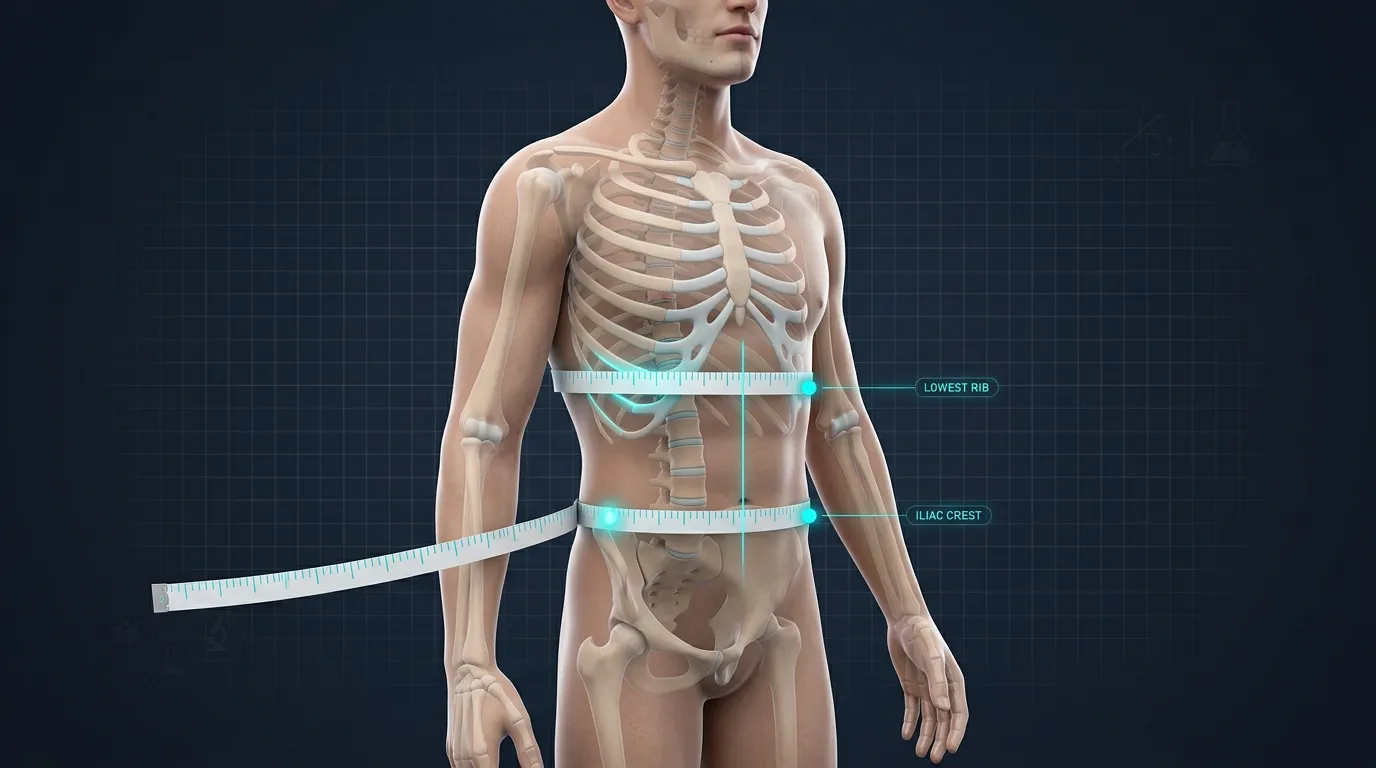
Anatomical landmarks: Locate the lowest rib (palpate the bottom of your ribcage) and the iliac crest (top of the hip bone, lateral position). Mark the midpoint between these two landmarks — for most adults this falls approximately at navel level.
Tape technique: Use a flexible non-stretching tape measure. Hold the tape parallel to the floor, snug against the skin but not compressing tissue. Exhale normally and do not hold your breath. Read measurement to the nearest 0.5 cm (0.2 inches).
Consistency rules: Measure in the morning before eating, standing relaxed with arms slightly raised. Repeat the measurement twice and use the average. Variability of ±2 cm between sessions can shift BRI by 0.3–0.5 points.
Height Measurement
Stand barefoot against a wall, heels together, eyes looking straight ahead (Frankfort horizontal plane). Use a wall-mounted measure or have someone place a flat object on top of your head perpendicular to the wall. Measure to the nearest 0.5 cm (0.2 inches).
Why BRI Outperforms BMI
BMI cannot differentiate between adipose tissue, lean muscle, bone density, or hydration. BRI incorporates waist circumference — directly measuring the body region where visceral fat accumulates and drives cardiometabolic risk.
The Same-BMI Paradox
Consider two adults both calculating BMI 26 (Overweight per WHO). Subject A measures 178 cm (5’10”) tall with a 78 cm (30.7 inches) waist — narrow torso, weight likely concentrated as lean muscle. Subject A’s BRI calculates approximately 3.0 — lean range with no elevated mortality risk. Subject B measures the same 178 cm tall but with a 102 cm (40.2 inches) waist — pronounced central adiposity. Subject B’s BRI calculates approximately 6.2 — elevated risk zone. BMI labels both as identical “Overweight.” BRI distinguishes the healthy individual from the at-risk one.
Validation Against DEXA
Thomas et al. (2013) validated BRI against dual-energy X-ray absorptiometry (DEXA) and total body water measurements in 7,011 NHANES participants. BRI demonstrated stronger correlation with visceral adipose tissue volume (r ≈ 0.70) than BMI achieved for the same parameter (r ≈ 0.48). The 2024 mortality validation by Zhang et al. confirmed clinical relevance — BRI predicted 15-year all-cause mortality with substantially better discrimination than BMI in the same NHANES cohort.
Limitations & Clinical Caveats
Smaller Research Base Than BMI
BRI was introduced in 2013 — its research base spans just over a decade compared to BMI’s five decades of clinical validation. The Zhang et al. (2024) mortality validation used U.S. adult NHANES data. External validation in Asian, African, and Latin American populations remains incomplete. Cross-ethnic interpretation of BRI thresholds should be cautious.
Sex Differences Not Adjusted
BRI does not account for natural sex differences in fat distribution. Women carry more peripheral subcutaneous fat (gluteofemoral) at equivalent BRI scores than men. The same BRI score in a man and woman may reflect different visceral adiposity profiles.
Waist Measurement Variability
Waist circumference measurement is subject to inter-observer variability, particularly in obese individuals where anatomical landmarks become difficult to palpate. Variability of ±2 cm — common between untrained measurers — can shift BRI by 0.3–0.5 points and potentially change classification zone.
Not a Standalone Diagnostic
BRI is a screening metric, not a diagnostic instrument. It does not account for ethnicity, family history, dietary patterns, physical activity level, or specific medical conditions. For comprehensive clinical assessment, combine BRI with body fat percentage, waist-to-hip ratio, and standard medical evaluation.
Clinical Reviewers & Citations
Based on Scientific Sources
- Thomas DM, Bredlau C, Bosy-Westphal A, et al. Relationships between body roundness with body fat and visceral adipose tissue emerging from a new geometrical model. Obesity (Silver Spring); 2013;21(11):2264-2271. → PubMed
- Zhang X, Ma N, Lin Q, et al. Body Roundness Index and All-Cause Mortality Among US Adults. JAMA Network Open; 2024;7(6):e2415051. → JAMA
- Rico-Martín S, Calderón-García JF, Sánchez-Rey P, et al. Effectiveness of body roundness index in predicting metabolic syndrome: A systematic review and meta-analysis. Obesity Reviews; 2020;21(7):e13023. → PubMed
- Ashwell M, Gunn P, Gibson S. Waist-to-height ratio is a better screening tool than waist circumference and BMI for adult cardiometabolic risk factors. Obesity Reviews; 2012;13(3):275-286. → PubMed
Complete Your Body Composition Picture
BRI captures body shape and visceral fat distribution. Pair it with BMI for general weight classification, body fat percentage for direct adiposity, and waist-to-hip ratio for cardiovascular risk. Together, these metrics provide clinical-grade body composition assessment in minutes.
Frequently Asked Questions
Body Roundness Index is a body shape metric introduced by Thomas et al. in 2013 that estimates visceral body fat using waist circumference and height. The formula models the human body as an ellipse using mathematical eccentricity borrowed from Kepler’s planetary orbit equations. BRI scores range from 1 to 16, with most adults falling between 1 and 10.
BRI scores between 3.41 and 5.46 are associated with the lowest all-cause mortality risk based on a 2024 NHANES study of over 30,000 U.S. adults by Zhang et al. Scores below 3.41 indicate very lean (narrow) body shape with 25% higher mortality at the U-curve low end. Scores above 6.91 indicate high roundness with up to 49% higher mortality risk.
BRI = 364.2 − 365.5 × √(1 − ((WC/2π)² ÷ (0.5 × H)²)), where WC is waist circumference in meters and H is height in meters. The formula treats the body as an ellipse with the waist representing the equatorial diameter and the height representing the polar diameter. The result quantifies body shape eccentricity from narrow (low BRI) to round (high BRI).
BRI incorporates waist circumference into its formula, capturing central fat distribution that BMI ignores. Two individuals with identical BMI can have very different BRI scores depending on waist size. BRI correlates better with visceral adipose tissue volume measured by DEXA (r ≈ 0.70 vs BMI’s r ≈ 0.48). However, BRI has a smaller research base than BMI’s five decades of validation. Both metrics complement rather than replace each other.
Measure waist circumference at the midpoint between the lowest rib and the iliac crest (top of the hip bone) — approximately at the navel level for most adults. Use a flexible tape measure held parallel to the floor. Exhale normally and do not pull the tape tight. Take the measurement to the nearest 0.5 cm (0.2 inches) for accuracy. Repeat twice and average.
BRI went viral after a JAMA Network Open study by Zhang et al. (2024) demonstrated a clear U-shaped mortality curve across BRI scores in over 30,000 U.S. adults. Major media coverage promoted BRI as a “better BMI.” The metric’s simplicity (only waist and height required) plus its mortality validation made it accessible for popular adoption while maintaining clinical credibility.
Build Your Complete Body Composition Profile
BRI captures body shape geometry. BMI captures weight classification. Body fat percentage captures direct adiposity. Together they provide complete clinical-grade composition profiling.
Explore All 8 BMI Alternatives