Body Fat Percentage Calculator: US Navy + Jackson-Pollock
Calculate your body fat percentage with two validated clinical formulas — US Navy circumference method or Jackson-Pollock 7-site skinfold. Both deliver ±3-5% accuracy versus DEXA scan, the gold standard for body composition measurement.
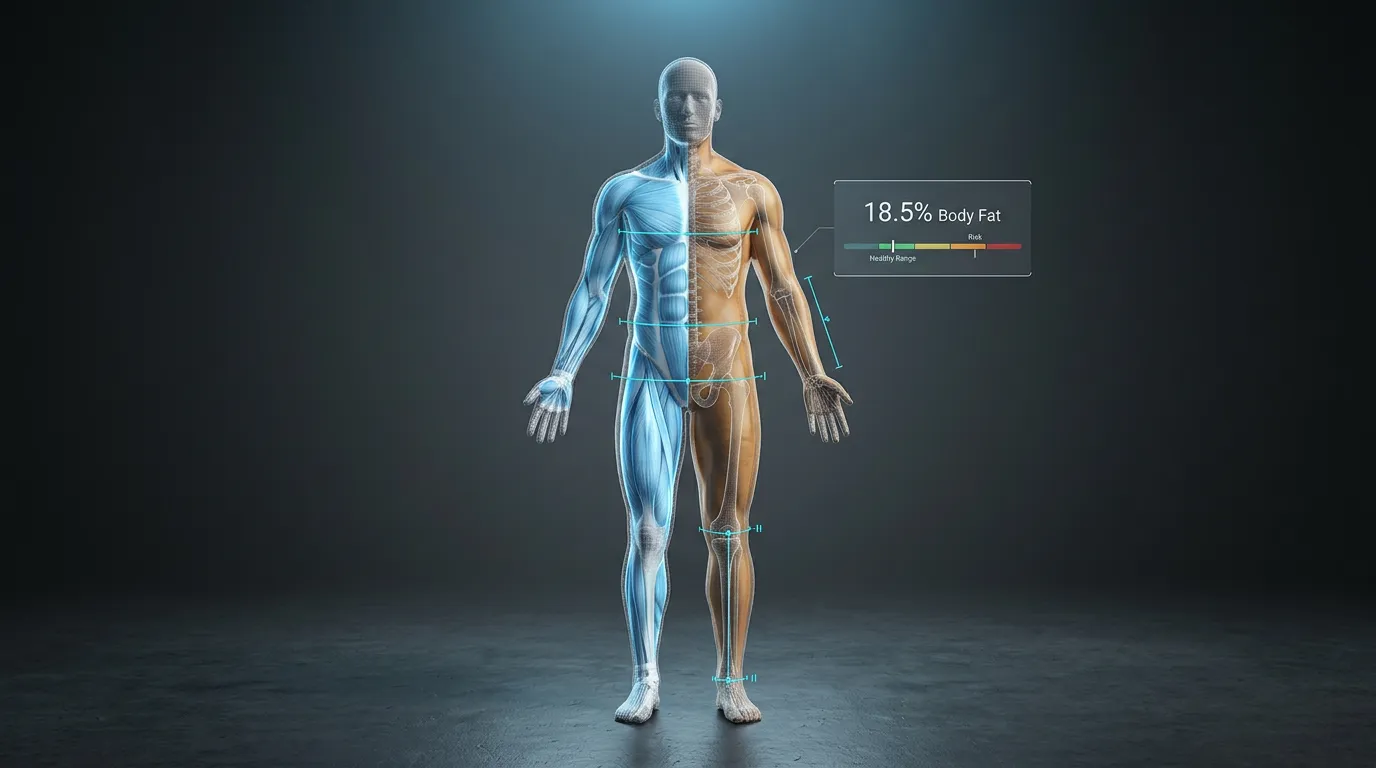
Body Fat Percentage (BF%) measures the proportion of adipose tissue relative to total body mass, providing direct body composition data that BMI cannot capture. Healthy ranges per ACE classification are 14-17% (Fitness) for men and 21-24% for women. Two validated formulas — US Navy circumference and Jackson-Pollock 7-site skinfold — deliver ±3-5% accuracy versus DEXA scan.
Body Fat Calculator
Awaiting Body Composition Data
Select measurement method, sex, and enter body measurements to receive ACE-classified body fat percentage, color-coded ring visualization, body composition breakdown, and clinical recommendations.
Clinical Recommendations
Two Validated Methods Explained
Both formulas have decades of clinical validation and deliver ±3-5% accuracy versus DEXA scan. Choose based on equipment availability and measurement experience.
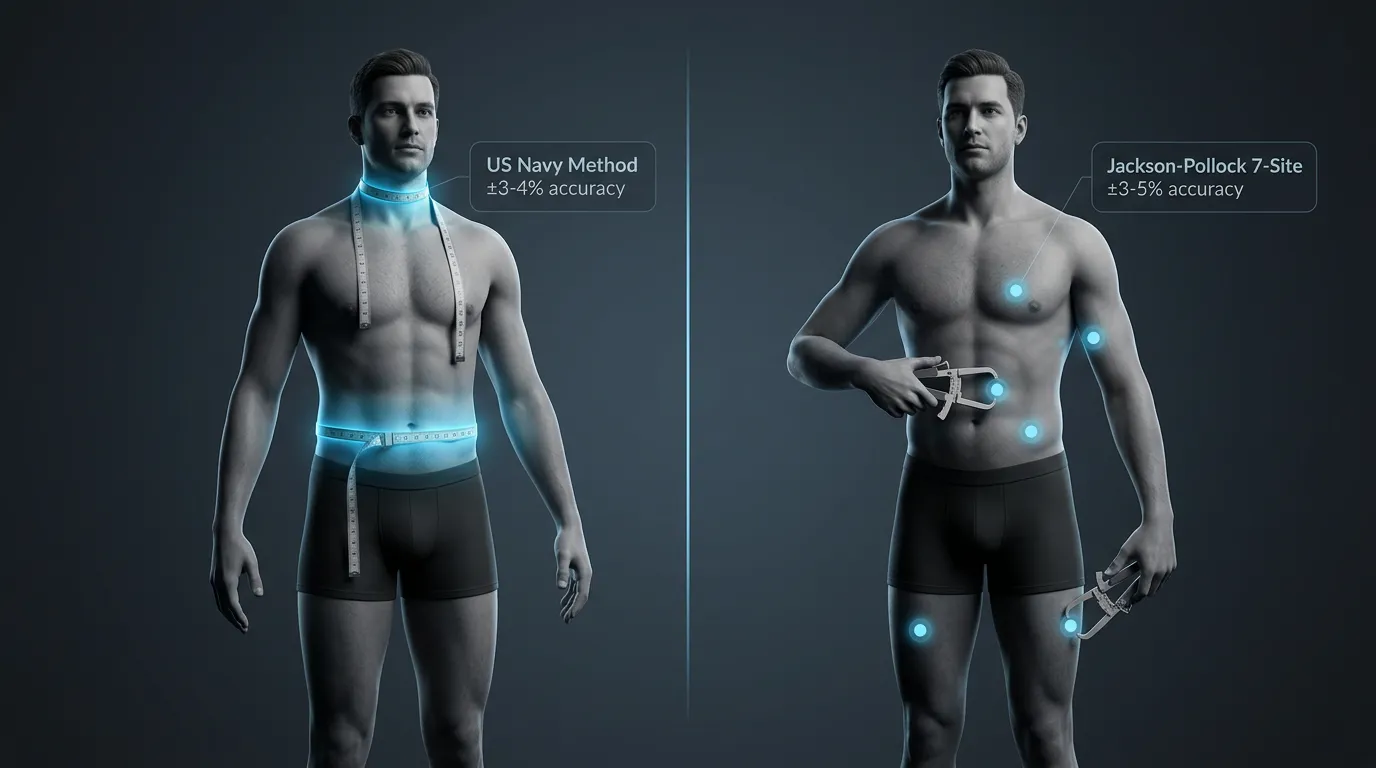
US Navy Method (Circumference)
Developed by the US Department of Defense in 1984 for routine military fitness assessment. Uses tape measurements at neck, waist, and hip (women) combined with height to estimate body density via logarithmic regression equations. Validated against hydrostatic weighing across diverse military populations (Hodgdon and Beckett, 1984). Accessibility makes it the most widely-used field method globally — requires only a flexible tape measure and basic technique.
Jackson-Pollock 7-Site Skinfold
Published by Jackson and Pollock in 1978 as the gold standard for skinfold-based body fat estimation. Measures subcutaneous fat thickness at seven anatomical sites using calibrated skinfold calipers. Body density is calculated via generalized equations incorporating age, then converted to body fat percentage using the Siri equation. Slightly more accurate than US Navy when performed by trained technicians, but requires equipment investment and measurement technique training.
ACE Body Fat Classification
The American Council on Exercise (ACE) classification system provides the global standard for body fat percentage interpretation, validated across multiple populations.
| Category | Male BF% | Female BF% |
|---|---|---|
| Essential Fat | 2 – 5% | 10 – 13% |
| Athletes | 6 – 13% | 14 – 20% |
| Fitness | 14 – 17% | 21 – 24% |
| Average | 18 – 24% | 25 – 31% |
| Obese | ≥ 25% | ≥ 32% |
Source: American Council on Exercise (ACE) Body Composition Standards
Essential Fat — The Physiological Minimum
Essential body fat is the minimum required for physiological function: 2-5% for men, 10-13% for women. This includes lipid components of cell membranes, nerve sheaths (myelin), organ padding, and substrate for reproductive hormone synthesis. Falling below essential fat thresholds carries significant health risks including hormonal dysfunction, immune compromise, and cardiovascular strain.
How to Measure Correctly
Accurate body fat estimation requires consistent measurement technique. Errors of just 1-2 cm in circumference or 2-3 mm in skinfolds translate to 1-2% body fat error.
US Navy Circumference Protocol
Neck: Just below the larynx (Adam’s apple), tape horizontal, slightly downward angle. Waist: Natural waist for men (around navel level), narrowest point for women (above hip bone, below ribs). Hip (women only): Widest point of the buttocks. Measure in the morning before eating, standing relaxed, breathing normally. Repeat each measurement twice and average.
Jackson-Pollock 7-Site Skinfold Protocol
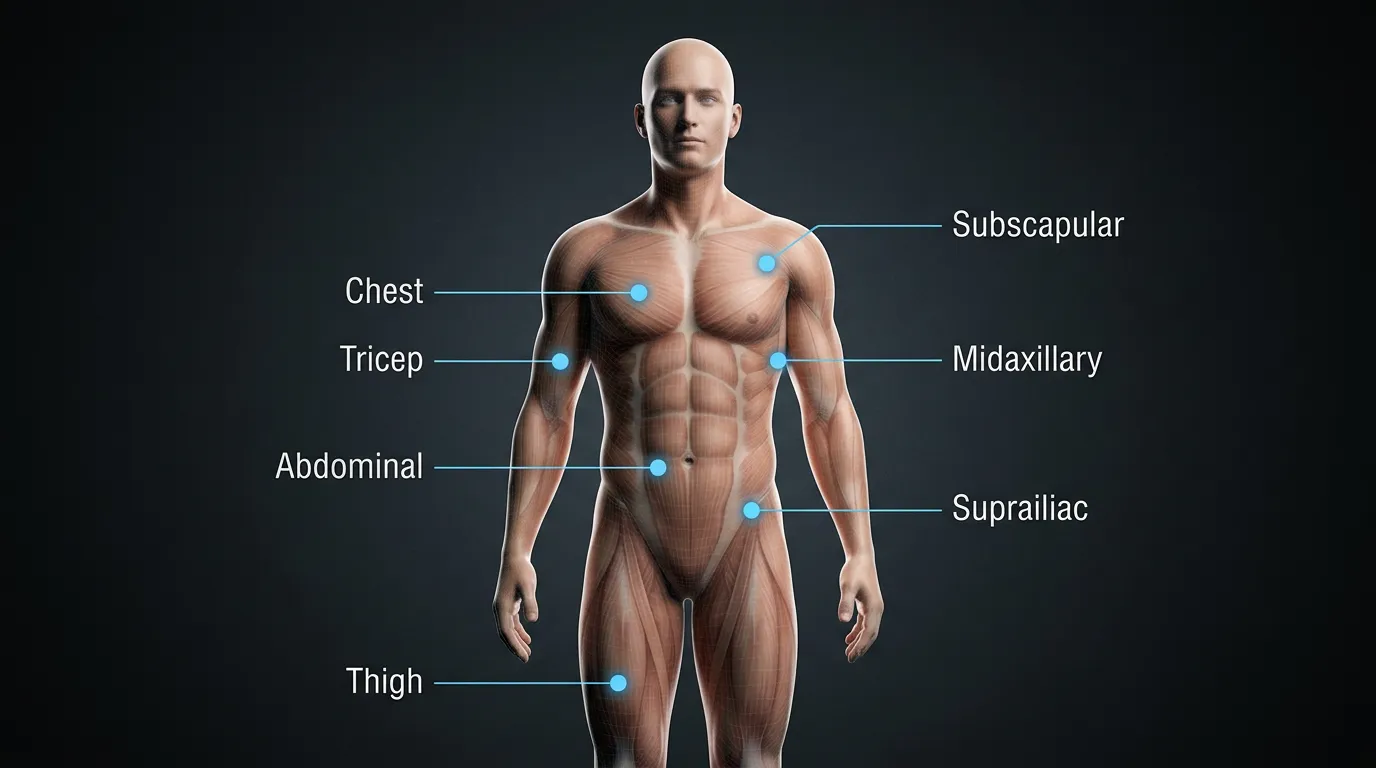
Site locations:
- Chest: Diagonal fold midway between nipple and anterior axillary line (men), one-third of distance (women)
- Abdominal: Vertical fold 2cm right of umbilicus
- Thigh: Vertical fold midway between hip and knee, anterior thigh
- Tricep: Vertical fold midway between shoulder and elbow, posterior arm
- Subscapular: Diagonal fold below shoulder blade angle, 45 degrees
- Suprailiac: Diagonal fold above iliac crest, anterior axillary line
- Midaxillary: Horizontal fold at sternum level, mid-armpit line
Pinch fold firmly, apply caliper 1cm below fingers, wait 2 seconds for reading. Take 3 measurements per site and use the median value.
Why Body Fat % Outperforms BMI
BMI cannot differentiate between adipose tissue, lean muscle, bone density, or hydration. Body fat percentage directly measures the relevant variable — adipose mass — providing clinically actionable composition data.
The Athlete Paradox: NFL linebackers average BMI 31 (BMI-classified obese) with 10-14% body fat (athletic by ACE). Standard BMI screening would flag them for weight loss intervention despite minimal cardiometabolic risk. Body fat percentage correctly identifies their composition profile.
The MONW Phenomenon: “Metabolically Obese Normal Weight” affects 8-30% of normal-BMI adults. These individuals carry dangerous visceral fat at BMI 20-24, invisible to BMI screening. Body fat percentage measurement catches MONW where BMI fails completely.
Limitations & Accuracy Caveats
Accuracy Tolerance
Both US Navy and Jackson-Pollock formulas carry ±3-5% measurement error versus DEXA scan. For a measured 18% body fat, true value likely falls between 13-23%. Single-point absolute accuracy is limited, but trend tracking over time is highly reliable when technique remains consistent.
Population Validity
Both formulas were validated primarily in adult populations aged 18-65. Application to elderly (65+), children, pregnant women, and extreme body compositions (BMI <18.5 or >40) reduces accuracy. Athletes with high muscle mass may also show overestimation in circumference methods.
Hydration Sensitivity
Skinfold measurements are sensitive to acute hydration changes. Measure at the same time of day, in the same hydration state, to minimize variability. Post-exercise or dehydrated state can shift readings by 1-2% body fat.
Clinical Reviewers & Citations
Based on Scientific Sources
- Hodgdon JA, Beckett MB. Prediction of percent body fat for U.S. Navy men from body circumferences and height. Naval Health Research Center; 1984.
- Jackson AS, Pollock ML. Generalized equations for predicting body density of men. British Journal of Nutrition; 1978. → PubMed
- Jackson AS, Pollock ML, Ward A. Generalized equations for predicting body density of women. Medicine and Science in Sports and Exercise; 1980. → PubMed
- Siri WE. Body composition from fluid spaces and density: analysis of methods. Techniques for Measuring Body Composition; 1961.
- ACE-sponsored Research. Body Fat Percentage Norms and Categories. American Council on Exercise; 2009. → ACE Fitness
Complete Your Body Composition Picture
Body fat percentage captures adipose mass. Pair it with BMI for general weight classification and WHR for fat distribution. Together, these three metrics provide clinical-grade body composition assessment in minutes.
Frequently Asked Questions
Healthy body fat ranges per ACE classification are 14-17% for men and 21-24% for women in the Fitness category. Essential fat minimums are 2-5% for men and 10-13% for women. Obesity is classified at 25% or higher for men and 32% or higher for women. The fitness range represents optimal cardiometabolic health for most adults.
Both methods achieve ±3-5% accuracy versus DEXA scan, the clinical gold standard. US Navy requires only tape measure and 3-4 measurements making it accessible. Jackson-Pollock 7-site requires skinfold calipers and trained technique but provides slightly better accuracy in trained individuals.
Validated formulas like US Navy and Jackson-Pollock achieve ±3-5% accuracy versus DEXA scan, which itself has ±1-2% measurement variability. For tracking progress, focus on consistent trend over time rather than single-point absolute accuracy.
Yes, for body composition assessment. BMI cannot differentiate muscle from fat — athletes register as obese, sarcopenic elderly appear normal. Body fat percentage directly measures adipose tissue, providing clinically relevant body composition data BMI cannot. However, both metrics serve different purposes in comprehensive screening.
Essential body fat is the minimum required for physiological function: 2-5% for men, 10-13% for women. This includes lipid components of cell membranes, nerve sheaths, organ padding, and reproductive hormone synthesis. Falling below essential fat carries significant health risks.
For tracking progress, measure every 2-4 weeks under consistent conditions. Body fat fluctuates daily with hydration, glycogen storage, and digestion. Take measurements in the morning before eating, at the same time, using identical technique for valid comparison.
Complete Clinical Body Composition Assessment
Body fat captures adipose mass. BMI captures weight classification. WHR captures fat distribution. Together they provide complete clinical-grade composition profiling.
Open BMI Calculator